The Real Question Isn’t “Which Is Better?”—It’s “Which Fits Your Workflow?”
Zero-point workholding exists for one reason: reduce setup time while keeping positioning repeatable. But in practice, shops choose between two common paths:
- Manual master plates (simple, flexible, low infrastructure)
- Pneumatic chucks (fast actuation, consistent locking, automation-friendly)
Both can work well. The smarter decision is based on how your shop schedules work and how disciplined you can be with standardization.
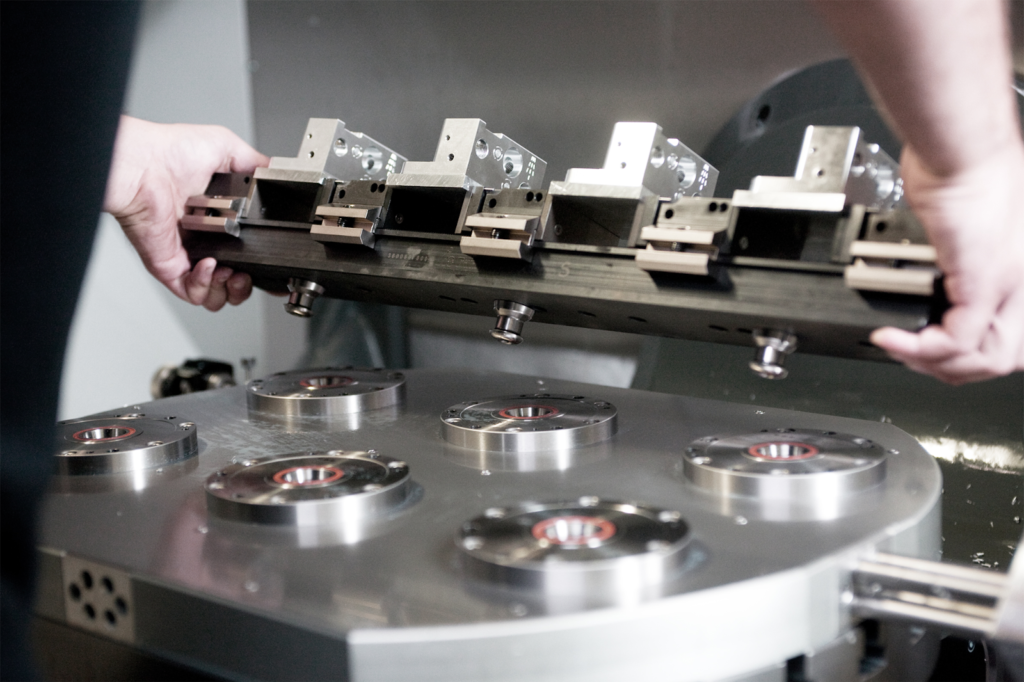
Manual Master Plate: Best for Mixed Fixtures and Interference Control
Xindian’s 8-hole zero-point quick-change system is described as a manually clamped master plate with 52×52mm and 96×96mm locating holes, compatible with D52/D96 pull studs.
The description also focuses on a practical advantage: quickly switching between hydraulic vise, or various-sized three-jaw chucks depending on workpiece size—minimizing machining interference and improving efficiency across diverse materials/dimensions.
Key claims/specs include:
- Up to 90% less set-up time
- Bearing capacity: 200 kg
- High repetition accuracy: 0.005mm
- Positioning and clamping in one operation
Where manual wins:
- high-mix scheduling (many different fixtures),
- shops that want a standardized base without air lines,
- teams prioritizing simplicity and fast training.
Pneumatic Chucks: Best for Repeat Batches and High Clamping Confidence
On the pneumatic side, the K20.3-C2 listing states:
- Up to 90% less set-up time
- High repetition accuracy 0.005mm
- Positioning and clamping in one operation
- a single zero-point body with holding force up to 55 kN and pull-in/locking force up to 17 kN
Those force numbers matter when cutting loads are higher or when you want extra confidence that the interface stays locked under demanding cycles.
Meanwhile, Xindian’s K40-C2 page frames the pneumatic chuck as commonly used in three-axis machining centers, with a row of mounting holes so it can be installed in the machine’s T-slot. It’s described as suitable for batch products, making interchangeable tooling plates, and quickly replacing plates after machining. The positioning holes are coordinate ground for precise fit with rivets.
Where pneumatic wins:
- repeated batch production and pallet-style workflows,
- need for operator-independent locking consistency,
- higher cutting demands where holding/pull-in force matters.
How to Choose Using a Simple “Shop Reality” Test
Choose manual first if:
- your biggest pain is switching between fixture styles (vise vs chuck, small vs large),
- clearance/interference changes job to job,
- you want a unified base platform across a range of work.
Choose pneumatic first if:
- your biggest pain is repeated batch setups and downtime,
- you want fast clamp/unclamp with consistent locking behavior,
- you want high holding force and pull-in/locking force as part of the spec.
A “Low-Risk Rollout” That Avoids Buyer’s Remorse
A practical strategy many shops follow:
- Start with manual master plate discipline
Build habits:5th axis vise labeling plates, cleaning interfaces, standard storage, consistent pull stud practices. Manual systems make it easier to establish operational standardization. - Add pneumatics on the highest repetition machine
Once your shop runs “plate thinking,” pneumatics become a strong multiplier—especially for repeat batches and quick plate swaps.
This approach avoids the common failure mode: buying pneumatics before your fixture library and interface discipline are mature.
Bottom Line
Manual and pneumatic zero-point both target repeatability and faster changeovers. Xindian’s manual 8-hole master plate emphasizes dual locating patterns (52×52 and 96×96), mixed fixture switching, 0.005mm repetition accuracy, and 200kg bearing capacity。
Pneumatic options emphasize 0.005mm repetition accuracy plus strong forces (55kN holding, 17kN pull-in/locking) and practical mounting/plate-swap workflow details.