Table of Contents
- Navigating China’s Green Yarn Market
- The Rise of China as a Sustainable Textile Hub
- Understanding “Sustainable” in the Chinese Context
- Key Categories of Chinese Eco-Friendly Knitting Yarns
- Major Production Regions and Industry Clusters
- Supplier Landscape: From Giants to Specialists
- Certifications and Standards: Verifying Green Claims
- Technical Specifications and Quality Benchmarks
- Pricing Structure and Cost Analysis
- Logistics, MOQs, and Supply Chain Considerations
- Risk Management and Due Diligence Strategies
- Future Trends and Market Outlook
- Strategic Sourcing Framework
- Frequently Asked Questions (FAQ)
1. Navigating China’s Green Yarn Market
China’s position as the world’s largest textile producer has evolved beyond cost leadership to include sophisticated sustainable knitting yarn production. China’s Sustainable Knitting Yarn Wholesale: A Comprehensive Guide This guide provides international buyers with actionable intelligence for sourcing eco-friendly yarns from China. Key findings indicate that China offers a complete ecosystem for sustainable yarns—from recycled polyester (rPET) at competitive global prices to innovative plant-based fibers and certified organic cotton—but requires careful navigation to distinguish genuine sustainability from superficial claims. Success in this market depends on understanding regional specializations, verifying certifications (GRS, OCS, OEKO-TEX), and establishing relationships with technically capable suppliers who can provide consistent quality and transparency. This report delivers the framework to transform China’s sustainable yarn potential into reliable supply chain advantages.
2. The Rise of China as a Sustainable Textile Hub
For decades, international buyers viewed China primarily as a source of low-cost conventional textiles. This perception has fundamentally shifted. Driven by domestic environmental policies, global brand sustainability mandates, and significant industrial investment, China has developed one of the world’s most comprehensive and scalable sustainable textile supply chains. For procurement managers, this represents both opportunity and complexity. The opportunity lies in accessing a vast array of eco-friendly knitting yarns with the efficiency and scale only China can provide. The complexity requires cutting through marketing noise to identify suppliers with genuine technical expertise, verifiable credentials, and commitment to continuous improvement in environmental performance.
3. Understanding “Sustainable” in the Chinese Context
“Sustainability” in China’s textile sector encompasses multiple, often overlapping pathways:
- Circular Economy Focus: Heavy investment in recycling infrastructure, making China a global leader in rPET and recycled cotton yarns. This is driven by both policy and economics.
- Cleaner Production: Adoption of advanced, less-polluting dyeing and finishing technologies (e.g., waterless dyeing pilots, digital printing) to reduce environmental footprint.
- Material Innovation: Development and commercialization of fibers from renewable sources (e.g., bamboo lyocell, milk protein fiber) and bio-based synthetics.
- Certification Adoption: Rapid scaling of production compliant with international standards like GRS, OCS, and OEKO-TEX, primarily for export markets.
- Supply Chain Transparency: Increasing use of blockchain and traceability platforms, though still in early stages compared to Western counterparts.
4. Key Categories of Chinese Eco-Friendly Knitting Yarns
Table 4.1: Major Sustainable Yarn Types from China
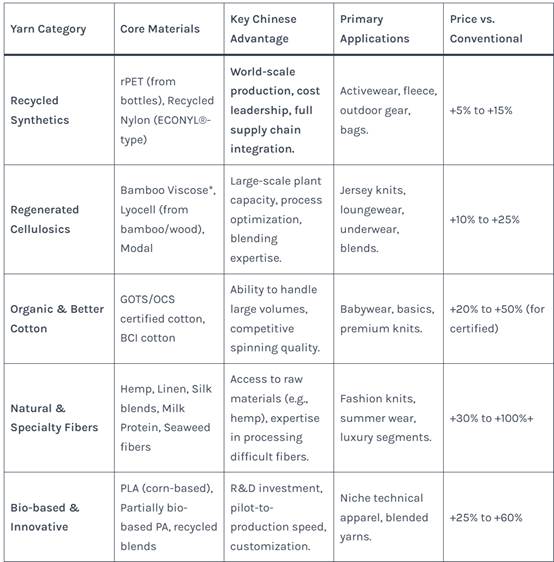
*Note: Buyers should scrutinize bamboo viscose’s chemical processing and seek closed-loop lyocell variants.
5. Major Production Regions and Industry Clusters
- Zhejiang, Jiangsu, Fujian: The heartland for recycled polyester (rPET) yarns. Cities like Shaoxing, Hangzhou, and Quanzhou host vertically integrated giants controlling from bottle flakes to finished yarn. Strong in functional and performance yarns.
- Shandong, Hebei, Xinjiang: Centers for cotton spinning, including organic and BCI cotton. Xinjiang’s role requires careful due diligence regarding supply chain regulations and reputational risk.
- Guangdong: Hub for innovation, regenerated cellulosics (bamboo/lyocell), and high-value fashion yarns. Strong in digital printing and finishing.
- Hunan, Jiangxi: Growing regions for hemp and linen yarn production, leveraging local agricultural resources.
6. Supplier Landscape: From Giants to Specialists
- Tier 1: Vertically Integrated Conglomerates (e.g., Hengli, Shenghong, Texhong). They produce sustainable yarns (especially rPET) as part of massive product lines. Pros: Scale, price stability, R&D. Cons: Less flexible on small MOQs, potentially slower on innovation.
- Tier 2: Specialized Sustainable Spinners. Mills dedicated to organic cotton, recycled fibers, or innovative blends. Pros: Deep expertise, flexibility, strong certification focus. Cons: May lack backward integration, more vulnerable to raw material price swings.
- Tier 3: Trading Companies & Agents. Can provide access to smaller mills and consolidate orders. Critical: Must verify they have direct mill relationships and technical knowledge, not just brokering.
7. Certifications and Standards: Verifying Green Claims
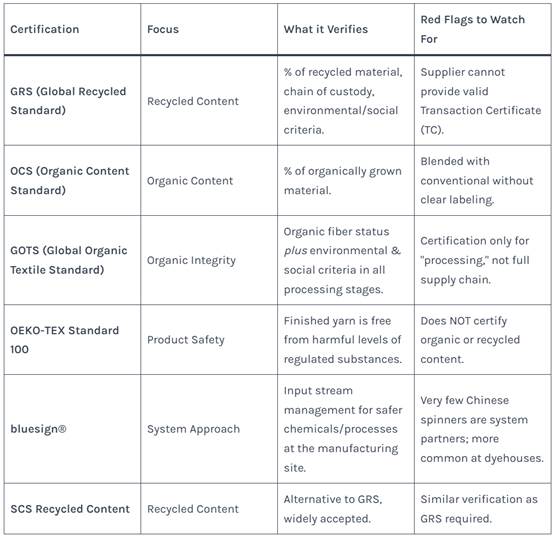
Table 7.1: Essential Certifications for Chinese Sustainable Yarns
8. Technical Specifications and Quality Benchmarks
Beyond certifications, quality is paramount. Specify and test for:
- Consistency: Evenness (Uster CV%), strength variation, and color uniformity across batches.
- Performance: Pilling resistance, shrinkage, colorfastness to washing and light.
- Processability: Yarn hairiness, break rate on knitting machines.
- Physical Properties: Tenacity, elongation, yarn count accuracy.
Chinese mills are increasingly capable of meeting high technical standards, but buyer specifications must be explicit and backed by testing.
9. Pricing Structure and Cost Analysis
- Cost Drivers: Raw material premium (e.g., GRS-certified flakes, organic cotton), certification/audit costs, smaller batch sizes for specialty yarns, and more expensive dyes/processes.
- Typical Price Premiums (FOB China):
- GRS rPET: +5% to +15% vs. virgin PET
- OCS/GOTS Organic Cotton: +25% to +50% vs. conventional
- Bamboo Lyocell: +15% to +30% vs. standard viscose
- Hemp blends: +30% to +60% vs. cotton
- Negotiation Leverage: High volume orders, long-term contracts, and willingness to work with standard color palettes can reduce premiums.
10. Logistics, MOQs, and Supply Chain Considerations
- Minimum Order Quantities: For standard sustainable yarns (e.g., rPET, basic organic cotton), MOQs can be as low as 500-1,000 kg per color. For innovative or small-batch specialty yarns, MOQs may start at 300-500 kg.
- Lead Times: Standard items: 30-45 days. Custom developments: 60-90 days. Factor in additional time for certification documentation.
- Shipping: Well-developed container shipping from major ports. Consider incoterms carefully (FOB vs. CIF). Sustainable yarns do not typically require special shipping conditions.
11. Risk Management and Due Diligence Strategies
- Verification is Non-Negotiable: Audit certification validity online via the certifier’s database.
- Demand Transparency: Request mill visit (virtual or in-person), traceability documentation back to raw material source.
- Start with a Pilot Order: Test quality, documentation flow, and communication before scaling up.
- Diversify Geographically: Consider sourcing from different regions within China to mitigate regional policy or logistical disruptions.
- Contract Specifics: Include certification compliance, testing protocols, and liability for false claims in contracts.
12. Future Trends and Market Outlook
- Chemical Recycling: Investment in technologies to recycle blended textiles into new, high-quality yarns.
- Carbon-Neutral Yarns: More suppliers offering carbon footprint calculations and offset options.
- Traceability Tech: Wider adoption of blockchain for fiber-to-yarn traceability.
- Bio-based Innovations: Scaling of PLA and other non-food-competing bio-polymers.
- Regulatory Push: China’s own “dual carbon” goals will continue to drive greener production internally.
13. Strategic Sourcing Framework
Step 1: Define Requirements (Certifications, material, technical specs, volume).
Step 2: Identify Supplier Shortlist (Focus on regions/clusters matching your needs).
Step 3: Conduct Technical & Commercial Q&A (Request samples, TDS, certification copies, audit reports).
Step 4: Perform Due Diligence (Verify claims, assess financial stability).
Step 5: Pilot & Contract (Start small, build relationship, formalize with clear terms).
Step 6: Monitor & Develop (Regular quality checks, collaborative improvement).
14. Frequently Asked Questions (FAQ)
Q1: Are Chinese sustainable yarns genuinely cheaper than those from Europe or India?
A: For volume orders of standardized products like rPET and basic organic cotton, China often offers a 10-20% cost advantage due to scale and integrated supply chains. For highly specialized, small-batch artisanal yarns, the advantage diminishes.
Q2: How reliable are Chinese GRS certifications?
A: The certification bodies (e.g., CU, ITS, SGS) are international. The reliability depends on the rigor of the audit. The risk is not in the certificate itself but in potential fraud behind it. Always verify directly with the certifier using the license number.
Q3: Can I source custom-developed sustainable yarn blends from China?
A: Yes, this is a growing strength. Many specialized spinners are eager to co-develop yarns (e.g., recycled cotton/hemp blends, rPET with enhanced softness). Expect higher development costs and longer lead times.
Q4: What is the biggest risk when sourcing sustainable yarns from China?
A: “Greenwashing” and inconsistent quality. A supplier may have one certified product line but sell uncertified material under the same claim. Rigorous sampling and testing of every batch are essential.
Q5: Is “bamboo yarn” from China sustainable?
A: It depends on the process. Conventional bamboo viscose uses heavy chemicals. The more sustainable option is bamboo lyocell (closed-loop solvent process). Always ask for specific process information and relevant certifications (e.g., OEKO-TEX, FSC for wood-based lyocell).
Q6: How do payments typically work?
A: Standard terms: 30% T/T deposit, 70% against copy of Bill of Lading. For new relationships, Letters of Credit are common. Established partnerships may move to more flexible terms.
Q7: Can I visit the mills easily?
A: For serious buyers, most reputable suppliers welcome visits. Post-pandemic, virtual tours via video call have also become an effective alternative for initial assessments.
Q8: How does China’s “Xinjiang cotton” issue affect sustainable yarn sourcing?
A: It necessitates extreme diligence. Many international brands require “Xinjiang-free” supply chains. You must explicitly state this requirement to your supplier and obtain signed declarations of origin. Traceability systems are crucial here.
Q9: What are the lead times for GRS-certified yarns with a custom color?
A: Allow 8-12 weeks from order confirmation: ~2 weeks for color lab dip approval, ~4-6 weeks for production (depending on queue), ~2 weeks for testing, certification (TC issuance), and shipping preparation.
Q10: Are Chinese suppliers knowledgeable about international sustainability regulations (e.g., EU Green Deal)?
A: The leading exporters are increasingly aware and are adapting their processes. However, it is your responsibility as the buyer to clearly communicate specific regulatory requirements and ensure compliance through testing and documentation. Don’t assume knowledge.